
Showing posts with label Greatest Hits. Show all posts

August 31, 2009

One of the most commented aspects of the weekend's memorials to the late Senator Edward Kennedy was a letter he wrote to Pope Benedict shortly before he died. In the letter, he described what had been his life's work, as well as his personal failings:
I was diagnosed with brain cancer more than a year ago and although I continue treatment, the disease is taking its toll on me. I am 77 years old and preparing for the next passage of life. I have been blessed to be part of a wonderful family and both of my parents, particularly my mother, kept our Catholic faith at the center of our lives. That gift of faith has sustained and nurtured and provides solace to me in the darkest hours. I know that I have been an imperfect human being, but with the help of my faith I have tried to right my path. I want you to know Your Holiness that in my nearly 50 years of elective office I have done my best to champion the rights of the poor and open doors of economic opportunity. I have worked to welcome the immigrant, to fight discrimination and expand access to health care and education. I have opposed the death penalty and fought to end war.

Those are the issues that have motivated me and have been the focus of my work as a United States senator. I also want you to know that even though I am ill, I am committed to do everything I can to achieve access to health care for everyone in my country. This has been the political cause of my life. I believe in a conscience protection for Catholics in the health field and I will continue to advocate for it as my colleagues in the Senate and I work to develop an overall national health policy that guarantees health care for everyone. I have always tried to be a faithful Catholic, Your Holiness, and though I have fallen short through human failings, I have never failed to believe and respect the fundamental teachings of my faith. I continue to pray for God's blessings on you and on our church and would be most thankful for your prayers for me.
In fact, pundits and pols who view the Roman Catholic faith as little more than a monolithic entity, obsessed with issues like abortion and gay marriage, as well as the best way to thwart investigations into pastoral pedophilia, miss the theological core of the Church, which has always been its message that faith can be measured only through action.

As an agnostic, I don't attend mass regularly anymore; in fact, other than the occasional marriage, baptism, or funeral, I almost never set foot in a church. But having been raised in the Church, the notion that you can serve God only by loving your fellow man is one that still motivates me, and influences how I live and what I believe. Perhaps the best encapsulation of the essential Christian belief comes from this oft-quoted passage, from the Book of Matthew, Chapter 25:
But when the Son of man shall come in his glory, and all the angels with him, then shall he sit on the throne of his glory: and before him shall be gathered all the nations: and he shall separate them one from another, as the shepherd separateth the sheep from the goats; and he shall set the sheep on his right hand, but the goats on the left.

Then shall the King say unto them on his right hand, Come, ye blessed of my Father, inherit the kingdom prepared for you from the foundation of the world: for I was hungry, and ye gave me to eat; I was thirsty, and ye gave me drink; I was a stranger, and ye took me in; naked, and ye clothed me; I was sick, and ye visited me; I was in prison, and ye came unto me.

Then shall the righteous answer him, saying, Lord, when saw we thee hungry, and fed thee? or athirst, and gave thee drink? And when saw we thee a stranger, and took thee in? or naked, and clothed thee? And when saw we thee sick, or in prison, and came unto thee? And the King shall answer and say unto them, Verily I say unto you, Inasmuch as ye did it unto one of these my brethren, even these least, ye did it unto me.
Clearly, the last sentence, in bold, describes the life and legacy of Senator Kennedy to a tee.

And what of those who believe that the best thing to do for the poor is nothing? To the free market libertarians of the day, and those who could have serenely let the Mary Jo Kopechnes of the world die of cancer because they happen to be uninsured, Matthew continues:
Then shall he say also unto them on the left hand, Depart from me, ye cursed, into the eternal fire which is prepared for the devil and his angels: for I was hungry, and ye did not give me to eat; I was thirsty, and ye gave me no drink; I was a stranger, and ye took me not in; naked, and ye clothed me not; sick, and in prison, and ye visited me not.

Then shall they also answer, saying, Lord, when saw we thee hungry, or athirst, or a stranger, or naked, or sick, or in prison, and did not minister unto thee? Then shall he answer them, saying, Verily I say unto you, Inasmuch as ye did it not unto one of these least, ye did it not unto me. And these shall go away into eternal punishment: but the righteous into eternal life.
Now, I'm not a believe in Hell, but a prolonged banishment for such folks into the political wilderness would suit me just fine.

February 18, 2008

Fan Shen: There seems to be a great disconnect out there between what bothers journalists and what bothers real people. With sports, we saw last week how that disconnect operates, when the jackasses in Congress spent an entire day trying to decide whatever it was Roger Clemens injected into his ass a full decade ago. For sportswriters, it was an issue of Clemens taking steroids and imperiling his HOF credentials. For fans watching the display, it was the comical sight of a former baseball icon ineptly lying, during a spectacle that was little different than the HUAC hearings fifty years ago, with friends being asked to snitch out friends.

One of the sad spectacles we are seeing now is the demand that baseball stars named in the Mitchell Report perform a public self-denunciation ritual that would have embarassed a Maoist satrap during the Cultural Revolution. One pitcher candidly discusses his use of HGH to recover from an injury, and he gets denounced by some harpy for not being contrite enough. Another great refuses to answer questions to a previous Congressional mob some years back, and it's as if he leaked the H-Bomb secrets to the Reds. So it's no wonder that the first inclination of some players is to issue the non-apology apology: Mistakes Were Made, I Regret Anything That May Have Offended Others, and I'm Sorry to Have Been a Distraction.

Fans, of course, could care less. Although there has always been a consensus point of view that the use of anabolic steroids is worthy of public admonishment, largely because they are both unhealthy for the user and give the user a competitive advantage, the use of HGH simply doesn't carry the same stigma, for good reason. The evidence that HGH has a deleterious impact on adult users simply isn't as overwhelming, and the motivation for using, to recover quicker from injuries, is one all fans can cheer. That it can also be used to more quickly recover from fatigue is more problematic, but I doubt there are any Dodger fans out there who regret being excited about seeing Eric Gagne coming into a game in 2004. Smoking pot is also against the law, but I doubt that will keep Barack Obama out of the White House this November.

Like the recurring media obsession with college athletes getting money under the table, it is a topic that simply doesn't resonate in the real world. Malum prohibitum violations rarely do, since all of us "cheat," to some extent. All of us overstay our time in a one-hour parking stop, hoping we don't get caught, and the fact that occasionally we do means we don't begrudge others for doing the same. But much like the a-holes on talk radio who obsess about the "illegals" coming across the border to pick lettuce at $5 an hour, sportswriters need a focus to vent their feelings of inferiority, so the Ritual Denunciation story about the Athlete Who Cheats is the hoary chestnut of the Toy Department.

January 11, 2008

Don't Play B-17: Google is a truly wonderful invention. Combined with our innate egotism as a species, its use has probably done more to shrink the world than any technological advance since the railroad.

Case in point: my first crush. When I was in fifth grade, I discovered that my life would be a drab, dreary affair if I could not win the affection of a beautiful red-headed girl named Sarah Cusk. Sarah was the best friend of my younger sister, Jennifer, and had the added distinction of being the smartest kid in school. That was a bit tough for me to take, since I was a) the smartest kid in my class; b) she was a year behind me; c) she was a girl, which also meant she was supposed to be yucky to my male classmates at St. Michael’s grammar school in North Hollywood; and d) she was a bit bigger than I was, even at that age, so I couldn't bully her the way I did my siblings.

She also had a bit of a “Veruca Salt” attitude that begged to be dropped down a peg. Most of my courtship of the lass consisted of me trying to prove how smart I was, and she shooting me down with some withering remark about what a stupid boy I was. So we became archenemies, my Newman to her Seinfeld, and whenever we were in the same room, we’d fight, with victory invariably going to the lady. She always had the knack of pulling the football away at the last second.

We had lots of opportunities to argue, too, since, as I heretofore mentioned, she was my sister’s best friend. In fact, her little sister, Rachel, was a friend of my other sister, Catherine (all of us attending the same tiny school). The Cusks were English, and together with another British family at my school, the Yarletts (their eldest daughter, Claire Yarlett, was Jenny’s other best friend), our families socialized together quite a bit.

At least a couple times each summer, and always during the pumpkin harvest before Halloween, our families would take trips together up to Santa Barbara, either in my mom’s station wagon, or in the vehicle that was popularly known as the “Cusk Bus.” The Cusk Bus was an early-70’s VW van, a precursor to the SUV, which you can still see on the roads today, although it’s usually in the context of it being impounded by the police from its meth lab or serial killer owners. Back then, though, if you owned one, you were definitely styling.

I was always a shy boy, so these outings, fraught with the tension of unrequited pre-adolescent love, always had the potential of unleashing my inner psycho. Even worse, Jenny, Sarah and Claire were all huge fans of Olivia Newton-John and Helen Reddy, whom I couldn’t stand, so these car trips usually featured some family sing-a-longs of “If You Love Me” or “Please Mister Please.” As I said, pure torture.

Finally, I graduated from grammar school in 1975, and around the same time, both the Cusks and the Yarletts returned to England, seemingly out of my life forever. The same social skills that I had honed to perfection with Sarah were put to use on other unfortunate women, and thirty years passed.

The other day, my sister Jennifer was at my house, and we decided to set up her Facebook page. Since one of the best uses for the online social network is to get in contact with old classmates, I thought I would use the search engine at the site to look for old friends of hers, and I discovered a “Sarah Cusk” living in Bristol, England. It turns out she’s about a quarter century too young to be the girl we went to school with, so I tried Google.

And lo and behold, I found her. Like many of the other women I’ve fallen for, she’s gone and had a pretty successful life, which I’ve always figured was simply the Tao of Smythe: if you can suffer my advances, and survive the clusterfuckery of my existence, good fortune beckons. One ex-crush from Cal ended up being a wealthy chiropractor in Avila Beach, California, while my great unrequited love from high school is now a much talked-about reporter for the New York Times. I have exquisite taste.

But Lady Sarah topped them. She ended up bouncing from elite school to elite school like an academic version of Randy Moss, no doubt attending some Oxbridge school Cambridge before getting a graduate degree at Harvard and a doctorate at Columbia. After that, she got married, taught at a university in Warwick, (or as they would say over there, “taught at university”), and now lives la vida loca with her husband and four children in Brussels. That seems like a nice life. Did I mention that I spend my days representing debtors in bankruptcy court?

Even more intriguing is the googlized story of her sister, Rachel Cusk. I seem to recall that little Rachel was dark-haired, unlike the others in her family, and was a sweet little girl who was inseparable from her sister, which included a shared Olivia Newton-John worship. Well, it turns out she’s gone and made herself into a major literary figure of the English language, a writer of Serious Fiction.

Incidentally, did you know there is an entire subculture of people who read Serious Fiction? Not merely “fiction,” in the sense of Grisham, Patterson, the Harry Potter stories, etc., or even in the sense of a Bush Administration press conference on the “surge,” but Serious Fiction. It’s a subculture that is disproportionately well-educated and wealthy, consisting of people who, for example, not only read the novel “Atonement” before the movie came out, but before “Atonement” had even been optioned.

Not only that, there’s a special supplement in most Sunday newspapers targeted at precisely this audience; in fact, there are even periodicals that are devoted to writers like Coetzee, Pynchon, DeLillo, and my ex-schoolmate. This subculture is almost as large as that of American fans of soccer, or tennis, and most of these people don't even have to read those books, having long since left college. They just read them because it's what they do. Who knew? And if reading John Updike or Martin Amis can get me laid more often, count me in.

In any event, Google only provides a superficial accounting of others, even public figures. With a little research, we can find out the notable accomplishments and failures of others, but not whether they are truly happy, or if they are a good friend to others. But it does mark out the location whenever our lives leave skid marks, insuring that neither time nor distance can totally erase each other from our existence. So wherever you are, Sarah, this is for you:

December 15, 2007

Sometimes the only thing worse than an LA Times sports columnist is an LA Times columnist writing about sports in another section of the paper, as this gem proves. The most treacly form of journalism is the column that expounds on the sociological roots of a sport, and baseball has always been the beneficiary of every hackpiece glorifying the bucolic, elegiac nature of the National Pastime and its confrontation with the cold realities of our corrupt society.

Screw that. It's a game that's played for our entertainment, to the pecuniary benefit of a few. Great athletes bend the rules, sometimes illegally, but always for the purpose of obtaining a competitive advantage; to that extent, stretching the envelope is what separates the star from the journeyman. I am no more shocked that so many of the game's stars were on the "Juice," the "Cream" and/or the "Clear" than I am at finding out that the models in the Victoria's Secret catalogue have all had plastic surgery, mostly performed during their teen years, in order to create an ideal "look" that's entirely unnatural for women. I wouldn't inject steroids or HGH into my body for a million dollars (or, at least not without the supervision of a licensed physician), but I really don't care if another adult makes a different decision, and I will no more hesitate to follow a sport than I suspect a woman would hesitate to purchase a camisole because Giselle has fake boobs.

Of course, if the overlords of the sport don't wish for the game to become a spectacle of angry, musclebound sluggers with receding hairlines and shrinking genitalia, they are more than free to impose whatever punishments they can for such transgressions, and negotiate with the Players Union any tests through the collective bargaining mechanism. I have zero sympathy for any of the active players exposed this week, all of whom had a chance to refute the charges, but decided to stonewall the investigators instead. They have a Fifth Amendment right to remain silent, and I have a First Amendment right as a citizen to draw whatever conclusions I want from said silence. If, like Roger Clemens, they feel aggrieved that their good names have been slandered, well, to quote the wee lad Will Poulter from School of Comedy, "croi me a forking river !!!"

But don't ask to me feel ashamed that I felt electrified every time Eric Gagne came into the game for the Dodgers in the middle of this decade. As far as I'm concerned, performance-enhancing drugs in the context of team sports are no different than college athletes receiving under-the-table payments from boosters, or immigrants crossing over the border without a visa to feed their families. If you get caught, you should pay the penalty, but I'm not going to lose a minute of sleep over it. [link via Matt Welch]

November 16, 2007

Waterboarding, or the "water cure," has been with us since the Inquisition, and has always been regarded as a particularly heinous and cruel form of torture. If you don't believe me, perhaps this state supreme court decision from the 1920's which overturned a murder conviction might give you pause:

The state offered the testimony above set forth, also testimony of confessions made by the appellant, Fisher. When the testimony was offered the witnesses tendered testified that the confessions were free and voluntary. No objections were offered to this testimony at that time, but subsequently the defendant, after the state had rested, introduced the sheriff, who testified that, he was sent for one night to come and receive a confession of the appellant in the jail; that he went there for that purpose; that when he reached the jail he found a number of parties in the jail; that they had the appellant down upon the floor, tied, and were administering the water cure, a specie of torture well known to the bench and bar of the country. The sheriff testified that he told these people not to hurt the appellant, and that the process was new to him as he witnessed it being administered to the appellant.

Several persons were introduced by the appellant who testified as to the presence of the parties in the jail and the administering of the water cure to Fisher and others jointly charged with the offense with him. The defendant also introduced a witness by the name of Hicks Ellis, who testified that he was in the party which administered the water cure to the appellant, and secured the confession thereby.

(snip)

We are satisfied that the court erred in receiving the confessions under the circumstances disclosed in this record. The Constitution of the state provides in section 26, among other things, that “the accused shall not be compelled to give evidence against himself.” This guaranty is violated whenever a confession is illegally extorted from a person accused of crime. In White v. State, 129 Miss. 182, 91 So. 903, 24 A. L. R. 699, the court, in the first syllabus of that case, held:

“Confessions induced by fear, though not aroused by spoken threats, are nevertheless involuntary, because the fear which takes away the freedom may arise solely from the conditions and circumstances surrounding the confessor.”
That case, in the methods resorted to to procure the confession, is a good deal like the one before us. There an ignorant negro boy was arrested, brought to the scene of a horrible murder, and after he was released by the authorities fell into the hands of infuriated citizens, who took him into a store building where the bloody corpse lay and a crowd of armed men were assembled, to obtain a confession. The boy confessed to one of the men, and then his hands were tied behind him, he was placed upon the floor, and a white man stood upon his body and administered to him the water cure, which consisted of pouring water into his nose. The court held that this confession was unlawfully obtained, and was therefore involuntary. It also held, in the third syllabus of the case, that:
“Where confessions were obtained at the scene of the murder by threats, duress, and physical violence, it was error to refuse to allow defendant's counsel to introduce testimony showing a connection between such involuntary confessions, and another confession to some of the same parties subsequently made at the jail to show that the same influence obtained in the latter confession rendering it involuntary.”

The bleeding heart judges who made that ruling, incidentally, were the members of the Mississippi Supreme Court. Eighty years later, a practice that was deemed too barbaric to justify even in the deepest part of Dixie, at a time when lynching was still a daily part of life in that state and much of the membership of the judiciary had ties to the Ku Klux Klan, is now a confirmed practice of the United States of America, something the President and the Attorney General will not say is torture. [link via Hit&Run]

November 09, 2007

Reason will not lead to Solution: When last we left the thorny subject of the current real estate implosion and its relation to bankruptcy law, the House of Representatives was considering legislation that would relax the current draconian restrictions on homeowners in filing Chapter 13 bankruptcies to stave off the Repo Man. The bill passed through sub-committee last month, and two weeks ago the Chief Economist for Moody's Corp. testified before the Judiciary Committee that one provision of the bill, which would permit the courts to modify the terms of a home mortgage, would save up to a half-million homes from being lost in foreclosure over the next year and a half.

This is such a sensible reform that I can hardly believe it has any chance of passing through Congress, let alone getting signed by the President. It would reamortize the secured amount of a home loan at the appraised value of the home, permitting homeowners to treat oversecured mortgages as unsecured, the same way owners of vacation homes and rental properties, of commercial real property, and family farmers can under the current law. It would also permit repayment plans that exceed the current five-year limit, and end the worthless requirement that debtors seek credit counseling as a precondition to filing a bankruptcy.

To those reforms I would add three others: raising the debt limit on Chapter 13 filings; eliminating the barrier that prevents homeowners from receiving discharges in Chapter 13 when they have filed a Chapter 7 within the last four years; and ending the presumption of abuse element. The current limits (just over a million dollars in secured debt, and just under $337,000 for unsecured debt) are particularly arbitrary for middle class homeowners, many of whom made the mistake of borrowing against the artificial rise in the value of their homes just before they needed hospitalization, or had a high judgment imposed against them or their business. The elimination of the 4-year barrier on Chapter 13 filings should be self-evident in this economy; many of the people who filed bankruptcies on the eve of YBK in October, 2005 also own homes, and not allowing them to save their homes would be unfair. And the presumption of abuse element, always the most controversial aspect of the 2005 law, forces many homeowners who simply wish to walk away from their property, into Chapter 13 (or its very expensive cousin, Chapter 11), benefiting no one, least of all the banks that are prevented from foreclosing by the automatic stay.*

But as I said, its chances for passage are dim, at least until after the 2008 election. Few Republicans in either house of Congress back the measure, and even if it gets out of the House, the likelihood that the Democrats could invoke cloture in the Senate, or even get a majority to support such reforms, is bleak. And by the time another session of Congress decides to act, the devastation to the economy that will no doubt be caused by the upcoming landslide of foreclosure sales will have already occurred.

*Its stated purpose, to discourage filings by middle and upper class debtors, has failed miserably; in the Central District of California, less than one percent of all affected cases get dismissed, in spite of all the time and paperwork the statute imposes.

UPDATE: Thanx to the good folks at Winds of Change for cross-posting this.

October 29, 2007

A few weeks back I noted how the ugly and racist use of the term "illegals" to describe a class of human beings was becoming increasingly routine, even in mainstream organs such as USA Today. Lawrence Downes makes a similar observation in the Sunday NY Times:
I am a human pileup of illegality. I am an illegal driver and an illegal parker and even an illegal walker, having at various times stretched or broken various laws and regulations that govern those parts of life. The offenses were trivial, and I feel sure I could endure the punishments — penalties and fines — and get on with my life. Nobody would deny me the chance to rehabilitate myself. Look at Martha Stewart, illegal stock trader, and George Steinbrenner, illegal campaign donor, to name two illegals whose crimes exceeded mine.

Good thing I am not an illegal immigrant. There is no way out of that trap. It’s the crime you can’t make amends for. Nothing short of deportation will free you from it, such is the mood of the country today. And that is a problem.

America has a big problem with illegal immigration, but a big part of it stems from the word “illegal.” It pollutes the debate. It blocks solutions. Used dispassionately and technically, there is nothing wrong with it. Used as an irreducible modifier for a large and largely decent group of people, it is badly damaging. And as a code word for racial and ethnic hatred, it is detestable.

(snip)

So people who want to enact sensible immigration policies to help everybody — to make the roads safer, as Gov. Eliot Spitzer would with his driver’s license plan, or to allow immigrants’ children to go to college or serve in the military — face the inevitable incredulity and outrage. How dare you! They’re illegal.

Meanwhile, out on the edges of the debate — edges that are coming closer to the mainstream every day — bigots pour all their loathing of Spanish-speaking people into the word. Rant about “illegals” — call them congenital criminals, lepers, thieves, unclean — and people will nod and applaud. They will send money to your Web site and heed your calls to deluge lawmakers with phone calls and faxes. Your TV ratings will go way up.

This is not only ugly, it is counterproductive, paralyzing any effort toward immigration reform. Comprehensive legislation in Congress and sensible policies at the state and local level have all been stymied and will be forever, as long as anything positive can be branded as “amnesty for illegals.”

We are stuck with a bogus, deceptive strategy — a 700-mile fence on a 2,000-mile border to stop a fraction of border crossers who are only 60 percent of the problem anyway, and scattershot raids to capture a few thousand members of a group of 12 million.
My solution to the problem, of course, is to deport anyone who uses, as a noun, the word "illegal," preferably to a country that I'm sure they would fit in more comfortably, like Iran or Burma. In the meantime, we keep the immigrants, legal, illegal or indifferent., and witness a better America.

September 05, 2007

Signifying nothing: From a blogger named Matt Stoller:
Also, while I'm doing a bit of ranting, stupid articles on what the 'netroots' does or does not do, such as this one or this one, to take but two examples, that ignore the fact that no top-tier Democrat differs from Clinton on Iraq, are really really stupid. They are much stupider than articles (like this one by Art Levine or this one by the usually-very-good Kevin Drum) that just whine inaccurately* about what 'the blogosphere' should have done as if the blogosphere is some top-down organization with centralized management that controls the Democratic party leadership rather than a network of people with somewhat highly trafficked websites held in mild disdain by most Democrats on the Hill with any decision-making authority or useful information. Although to be fair to the previous two really stupid articles, the latter two stupid articles were pretty stupid.
Huh? Well, feel free to rant away, Mr. Stoller, but it wouldn't hurt to get a f**king clue. Lefty bloggers are great at raising money for causes, for garnering attention to worthy causes, and for publicizing dark horse challengers, but on a tactical level, they have all the sense of a cage of spastic ferrets being harassed by a deranged hive of wasps. Bloggers can get a Ned Lamont nominated, but actually electing him, or avoiding doing really airheadish things that rile up the opposition, is another thing entirely.

Stoller's notion that blogs doesn't have "top-down" organizational control is technically correct (for one thing, traffic-wise, political writing is a relatively insignificant part of the blogosphere), but it still obscures the very negative role the Queen Beez play in determining what the agenda is for the rest of the non-MSM. If anything, it's "pretty stupid" for Stoller to pretend that within the lefty blogosphere, there aren't about a dozen bloggers who link almost exclusively to each other, who generate 99% of the press coverage, and thereby set the agenda for the rest of us.

Like it or not, that exclusivity can be a strength, since it keeps us on message and magnifies our influence, but it also backfires on occasion, as Mr. Drum points out in the post referenced above. Depending on the season, we are told by the Queen Beez that we have to elect more Democrats to Congress, no matter what position they take, or we are told that we have to purge the "Bush Dog" Demos at the first chance, or we just sit back and make snarky quips about "Friedman Units" and post photoshopped pics of Joe Lieberman. With that sort of de facto leadership, it's no wonder we feel like we get snookered at every turn.

*BTW, how does anyone "whine inaccurately" about anything? "Whining" connotes an undignified, childish complaint; it's not a verb that can be properly modified by an adverb relating to the accuracy of the complaint, since whether the whine is true or not is irrelevant. In any event, if you are going to complain about the whining of others, it would be best not to adopt such a prissy, petulant tone.

June 22, 2007

I have never known a day in my life without my grandmother, Clara Alice Robinson. Every child who is blessed with a grandparent knows the unique joy that relationship brings. An older, loving figure you can put on a pedestal without any of the fears or anxieties you have with your parents; love and affection without discipline or question. In my life, “Grandma” was always that person.

I have lived in a house with her, or in a house she owned, for most of my life. When I was four, my parents were going through some hard times, and she and her late husband, Jim Robinson, invited me and my siblings to live with them until things got sorted out. One year became two, then four, and so on, until the next thing we knew, we were under their roof for more than twenty years, long enough for my mom and dad to send me and my two sisters and brother to college (and me to law school). And for much of that time, our household also included her mother (my great-grandmother), as well as the family of her other daughter, after they moved here from Wigan.

It wouldn’t be accurate to say that she taught me how to read, or to add, or gave me my passion for current events and for American history. I have a lot of teachers to thank for that, as well as my mom and dad. But Grandma was always there to read me a book when I was little, or to help me count to a hundred, or what was the correct pronunciation of “Czechoslovakia” when I was browsing the encyclopedia when I was six. Every night, without fail, she would pour me a bowl of cereal before I went to bed; that went on ‘til I was about 16. To this day, the best reason I’ve ever been able to come up with for having children of my own is to expose them to this great, sweet lady.

She had a sharp wit, and until recently, did not look or act anywhere close to her age, which was 92. She watched "The Price Is Right" and "Young and the Restless" each morning, and any Grand Slam event in pro tennis, but other than that, she was a CNN junkie, and had an opinion about everything. She never got over the fact that the people of her home state elected an Austrian bodybuilder to be their chief executive; she was still amazed than an actor could get elected President.

During WWII, she had worked in a factory on the home front, a genuine Rosie the Riveter. She never tired of telling me the story about how her father, an immigrant from England (by way of Edmonton, Alberta, where she was born), ran afoul of the KKK when they were marching in the mid-1920’s, refusing to doff his hat at the American flag they carried when they paraded by. He had taught her the lessons she would later teach her daughters, and then her grandchildren: that prejudice is a fool’s game, and we should take people as they come, not as we wish them to be.

Her idiosyncrasies were legendary in our family. She never learned to drive a car. She hated being photographed, which was especially odd since she wasn’t a bad-looking woman even at the end. She ate sparingly, and every day would down at least one hefty-sized bourbon and ginger ale; let’s just say she preferred her bourbon dry.

Two years ago, she fell at her house, suffering a cracked knee cap, and I don’t think she was ever the same physically. She began using a walker to go everywhere, and after awhile, a wheelchair, and a lot of the enthusiasm she had for life suffered. She could still perk up when my nephew (now almost four) came by to visit, and she adored her pet dachshund/Chihuahua hybrid, “JR” (named after my granddad), but mostly, she just sat, meditating on her long life, and probably, those loved ones who had passed on before her. Regardless, she always had time for visitors, and her big heart ensured them that they would always have a welcome place in our home.

In mid-April, when I was over at her house, she fell face first in the kitchen. We took her to the local hospital, where they stitched her up, but the toll had weakened her. What we didn’t realize at the time was that she had suffered a stroke. When she continued to seem lethargic and unresponsive after she returned home, we booked her into a hospital bed at Providence-St. Joseph’s Hospital in Burbank, where the doctors’ diagnosis turned out to be our worst fears.

For the last four weeks, she battled, showing a reservoir of physical strength we didn’t imagine she possessed as various tubes and oxygen masks were tried on, in an effort to rehabilitate her strength. Slowly, she came back to us, in spite of what must have seemed to her like a torture right out of the Inquisition. Always, her repeated goal was for us to take her home, and on Sunday, the doctors told us that the chances for her were good; that she would be moved to the rehab unit, and arrangements could be made to bring her home shortly. Even in that false spring, it was clear that her time at the hospital had taken a great deal out of her, and she would never be that same person whose self-deprecating wit and rambunctious laughter brightened the lives of all around her.

Early this morning, she took her leave. Her last hours were spent surrounded by her family, in the comforting bed of her home. When she returned for the last time, her eyes seemed to sparkle, as if she knew she was finally going to get some peace and quiet.

I suppose in the traditional obit, it would mention she was a widow who was survived by two daughters, eight grandchildren, and seven great-grandchildren (and another one on the way), as well as numerous other nieces, great-nephews and what-not. But like so many other people whose names never make it into a newspaper at the end of her life, she touched so many other people, too numerous to count.

She will be missed. I know there will be times of joy in my life, to go along with this day of sadness. But it strains me to think about how not having her with me, in the present, will temper any happiness. It won’t be the same without her.

Clara Alice Robinson (1915-2007).

July 20, 2006

Little Green Firedogs (Pt. 2): On Bill Clinton's decision to campaign for St. Joseph:
Big Dog may not have taken it personally when Lieberman stabbed us all in the back with his speech on the floor of the Senate during the impeachment hearings, but many of us did. Loyalty to machine politics runs deep.
"Stabbed us all in the back?????" Of all the reasons one should support Ned Lamont, the fact that his opponent attacked President Clinton for lying under oath about an affair with an office underling should be way, way down on the list.

Hey, I love Elvis, thought he was the best President of the last half-century, hated Ken Starr and his GOP masters in Congress, and strenuously opposed the impeachment of the President. The entire matter was a ginned-up attempt to nail a politician they hated, and should be correctly regarded as one of the most distateful periods in American political history. Thanks to the GOP, the use of the impeachment mechanism to remove a President will be seen as a partisan stunt for a long time to come, something that a Congressional majority does to register its displeasure with a President of the opposing party.

But anyone who is so morally abtuse as to regard Clinton's behavior during the Lewinsky Affair as appropriate, not worthy of censure, really has a hollow core. In the autumn of '98, Clinton didn't do anything to earn our loyalty with his boorishness and dishonesty, so how can anyone other than his most obsequious retainers feel that Lieberman "stabbed us all in the back." Fighting for liberal principles doesn't entail putting on our collective kneepads everytime a Democrat is under attack for his sleazy transgressions.

June 18, 2006

South Korea 1, France 1: Park ji-sung became the third Man Utd. player in as many days to play the hero, scoring in the 82nd minute as the Koreans rallied to tie Les Bleus. Thierry Henry of Arsenal had earlier put the French into the lead, notching their first goal in World Cup since the 1998 Final. More referreeing controversies occurred in the first half, when an apparent French goal was not called, and in the second half, when Zinedine Zidane received a yellow card that will keep him out of France's final group game (and may end his career), and marred the game. It will be difficult for anyone watching the game to get that ditty the Korean fans were singing out of his head.

One of the stars for France is their bald goalkeeper, Fabien Barthez. Barthez, who at one time was romantically involved with former supermodel Linda Evangelista, bears an uncanny resemblance to the late character actor, and original "Dr. Evil", Donald Pleasance, whose perhaps most famous for his recurring roles in the Halloween movies. But Pleasance earned a special place in movie lore for starring in films featuring two of my favorite actresses. In Cul de Sac (1966), directed by Roman Polanski, he played the owner of a castle who is visited by a mobster on the lam, along with his girlfriend, who is played by Francoise Dorleac. Ms. Dorleac was on the cusp of stardom when she was killed in an auto accident the following year, at the age of 25, and she was, almost impossible to believe, the prettier older sister of Catherine Deneuve. And of course, Pleasance also played the father of Smythe's World icon Phoebe Nicholls in Blade on the Feather (1980), a deliciously tawdry spy thriller in which my blogmuse, playing a spoiled young adult version of Varuca Salt, gets nekkid with co-star Tom Conti. Neither Dorleac or Nicholls really have anything to do with Fabien Barthez, Dorleac having died the year before Barthez was born, and there being no evidence that the infrequently-working Engish character actress has ever met the French goalkeeper, but as Nicholls' character would say in the above movie, "come on daddy, play the game...."

June 05, 2006

Huh? Mickey Kaus approvingly links this morning to one Thomas Lipscomb on the Swift Boat allegations from two years ago, calling him "the nation's leading expert on why not all of the Swift Boat veteran allegations against Senator John Kerry are discredited." The column in question states that Mr. Lipscomb has been "nominated for a Pulitzer for his reporting on Kerry during the 2004 elections." Wow, and I always thought the allegations attacking Senator Kerry's war record had been discredited...but since it turns out the person investigating those allegations had been nominated for the highest award given to journalists in this country, we should all have second thoughts on the traitorous coward who almost became our Commander in Chief....

One problem: the Pulitzer Prize website actually lists the people and newspapers who were nominated in 2004, 2005 and 2006, and Mr. Lipscomb's name appears...nowhere. [link via Pamela Leavey] In fact, if you search the Pulitzer archives, not only has Thomas Lipscomb never been a nominated finalist, no one with that last name has been so honored, nor was anyone else for "reporting on Kerry during the 2004 election". According to the website:
Nominated Finalists are selected by the Nominating Juries for each category as finalists in the competition. The Pulitzer Prize Board generally selects the Pulitzer Prize Winners from the three nominated finalists in each category. The names of nominated finalists have been announced only since 1980. Work that has been submitted for Prize consideration but not chosen as either a nominated finalist or a winner is termed an entry or submission. No information on entrants is provided.
OK, so maybe Lipscomb was an "entrant" for the 2004 Pulitzer Prize. To be an entrant, you have to fill out the entry form, and anyone who has published something in a daily newspaper is eligible. Although "many newspapers prefer to submit entries of particular staff members or achievements," that doesn't matter, since the nomination can be "made by newspaper readers or an interested individual." For example, the brilliant writer who penned this Op-Ed piece for the L.A. Times last October, on the YBK problem, could have feasted on the reflected glory of the most prestigious prize in American letters, had he simply sat down and taken five minutes to fill out the application, and sent it out with the warmest regards to the Nominating Jury. And, best of all, its free it only costs $75.

So I suppose it would be like Jennifer Lopez claiming she was "nominated" for an Oscar for her work in Gigli. Her name wasn't one of the five contenders rattled off on the last Sunday in February, but I'm sure someone (her publicist?) voted for her. It's a neat, harmless way of building up your resume, in much the same way that Tookie Williams was a Nobel Peace Prize "nominee" (actually, it is even less impressive than those two examples, since the Oscar and the Nobel have closed nomination processes). What it has to do with the truth, however, is anyone's guess.

UPDATE: Apparently the Pulitzer nomination claim is an ongoing part of Lipscomb's reputation. Both the U.S. News & World Report and columnist Liz Smith have cited his "nomination" in recent articles about his latest bit of investigative reporting, into the alleged tampering of the Zapruder Film.

April 03, 2006

That Lynn Swann was an overrated player, undeserving of Hall-of-Fame stature, is something that has become such conventional wisdom for so long that I hadn't paid it much mind until I read this piece, by Chris Bowers at MyDD, attacking his election to the Hall in 2001. Having now looked at the numbers used to discredit Swann, who is running for the governorship of Pennsylvania, I was surprised to find that, in fact, his credentials for the Hall were as strong as they were.

Bowers makes three basic arguments: that Swann's career numbers are unspectacular, that he was not a dominant receiver even in his prime, and that he doesn't compare well with John Stallworth, a teammate of his with Pittsburgh who was also elected to the Hall. None of his arguments holds water.

First, not being from Pennsylvania, I can't attest to how much of his current campaign is based on his Hall-of-Fame membership, but as far as whether someone should be in, in spite of low career numbers, well, that ship sailed a long time ago. Gale Sayers is perhaps the best example of someone with low career totals being a HOF member, but Joe Namath is also a member of the Hall, notwithstanding the fact that his career totals as a quarterback were, shall we say, not spectacular. Among the QB's ranked ahead of Joe Willy for most yards passing are Norm Snead, Mark Brunell, Joe Ferguson and Rich Gannon, none of whom are even plausible Hall-of-Famers. Wisely, the voters ignored that, as well as the fact that most of the prime of his career was spent playing in a minor league, and gave more weight instead to who won Super Bowl III.

Like Namath, Swann compiled unimpressive career numbers because he played a short career (only nine seasons), and played hurt during most of it (he was particularly susceptible to concussions). Moreover, the Steelers had the best running game in the sport for most of the decade, and more frequently than not, had the lead entering the fourth quarter, so they were near the bottom most of the time in pass attempts. In fact, during his career, the Steelers ran the ball on almost 60% of their offensive plays. And there was far less passing in the game than there would be in the 1980's and 1990's, when most of the all-time statistical leaders played. Any opportunity for Swann to pad his stats in order to be among the league-leaders was almost nil.

As for him being a mediocre receiver in his prime, who conned his contemporaries into idolizing him because of a few, endlessly-replayed catches, he was selected to the Pro Bowl three times, and was the best reciever on one of the all-time greatest teams in the sport's history. In any event, claiming that Swann was elected because of the voters were "endlessly subjected to watching replays of two or three of his most spectacular catches", is silly; the catches being referred to were in the freaking Super Bowl (two of them, to be exact, against the hated Dallas Cowboys). Of course those plays are going to carry a little more weight than what John Jefferson might have done against the Chiefs in a mid-season game in 1978. When it counted, Swann came up big.

The fact of the matter is, the Steelers were not a Super Bowl team before Swann arrived, even with Bradshaw, Harris and the Steel Curtain, and immediately fell out of contention for a decade after he retired. But while he played, they won the biggest prize in American sports four times in six years.

Lastly, comparing Swann with Stallworth, who is also a HOF receiver, is a bit foolish, since both were exact contemporaries from 1974 to 1982, and Swann's numbers were superior in each category save yardage-per-catch. If Swann played on the same team with another HOF player, at the same position, for nine seasons, and had better numbers, isn't that clear evidence that he was a Hall-of-Fame caliber player? Or at least, not the worst player at his position in the Hall?

Bowers' real point, though, is to attack Lynn Swann, gubernatorial candidate from Pennsylvania. The Democratic incumbent, Ed Rendell, endorsed the Supreme Court nomination of Samuel Alito, and is basically a Gentile version of Joe Lieberman (or the Gray Davis of the East, if you prefer). In short, he is not the sort of Democrat that any liberal should go to bat for, the marginal HOF credentials of his opponent notwithstanding.

February 11, 2006

The worst person in sports, and perhaps in a whole realm of endeavors, is Dick Pound, the autocrat charged with running the World Anti-Doping Agency. Case in point: yesterday's one-year suspension of American medal hopeful in the skeleton, Zach Lund. Mr. Lund was booted out of the Olympics following detection of the anti-baldness medication, Propecia, after a blood test last November. Propecia has an ingredient that can be used to mask steroid use, although it would take an intake of massive proportions for it to have that intended effect.

And Lund, 26, is clearly an individual who has reason to take the drug, a conclusion reflected in the Court for the Arbitration of Sports, which upheld the penalty in spite of issuing a finding Lund to "be an honest athlete, who was open and frank about his failures", and ruling that "it was entirely satisfied that Mr Lund was not a cheat". In fact, Lund had disclosed his use of the drug for some five years before the hammed came down this time, and it took more than a year for the drug screeners to even find the trace amounts of the masking ingredient in his system.

Enter Mr. Pound, whose previous notoriety on this site came last summer, in his role in backing a fraudulent attempt to "test" Lance Armstrong, as well as his frequent attacks on the sports of baseball, soccer, and ice hockey for not dishing out lifetime bans to first-offenders. Pound, exulting over his ability to crush the dreams of an athlete over a technicality, stated that whether or not Lund was a cheat was beside the point:
There have to be other treatments for hair loss, for hair replacement, than stuff that is a masking agent — that are on the prohibited list. I think he was lucky to get one year, frankly. (emphasis mine)
Damned lucky, I'd say; now he won't miss any big competitions in 2007.

In addition to being a clueless asshole, Pound may have done more than anyone to completely discredit his movement for the public to take performance-enhancing drugs in sports seriously. If Lund is not a cheat, if he's taking Propecia to stop male-pattern baldness, without the high blood pressure side effects that other drugs (like Rogaine) have, and not to mask the use of anabolic steroids, which is what the regulation is designed to stop, he shouldn't receive any suspension, much less one that will take him out of a competition he's spent his lifetime gearing for. And he shouldn't have some smug little hitler suggesting that he should have gotten a hair transplant instead.

June 01, 2005

YBK: When the 2005 Bankruptcy Reform Act was signed by the President on April 20, one of the predictable consequences was that we would see a surge in bankruptcy filings before the law would go into effect six months later. A similar increase occurred in March and April, 2001, when the same bill almost passed both houses of Congress. Sure enough, since the media first began to focus on the bill as it was winding its way through Congress, in early March, filings have gone up dramatically nationwide, as people delinquent on their debts attempt to get in before the laws become more stringent. Bankruptcy petitions went up 60% in the month immediately after the Senate passed its version, setting a monthly record of 165,459, and were 8.5% higher than they were the previous March. In April, that record was broken: 170,130 people sought bankruptcy protection, a 16% gain from the previous year.

As an attorney who has practiced bankruptcy law for over a dozen years, there has been plenty of anecdotal evidence I can attest to, from a hiring surge at local firms specializing in creditor representation to an increase in inquiries from potential clients, who ask if they can still file bankruptcy “before it’s too late”. One of the ironies of the passage of the recent law is that it has proven to be a boon to bankruptcy professionals, both in the form of higher filings before it goes into effect, and the potential to provide clients with more billable services afterward.

This trend can be seen throughout the country, In Colorado, bankruptcy filings were up 24% from a year ago in March and April; in Iowa, a 25% increase; in Ohio, one district reported a surge of 16% in April, and a 27% increase for the month of May. In Utah, a state whose filing rate has been almost twice that of the national average since 2000, Chapter 7 filings nearly doubled their yearly total in March and April alone, even though the total number of bankruptcies remained steady. And in Hawaii, filings for the month of May were up almost 35% from the numbers for the previous year.

In the federal district in which I practice, the Central District of California, the increase has been more modest; a 3.4% rise in March and April of this year, compared with the same period last year. In terms of bankruptcy filings, the Central District has traditionally had the highest figures in the nation, as well as being on the cutting edge of some of the more innovative forms of bankruptcy fraud. Due largely to the high percentage of immigrants, who are more susceptible to the entreaties of “paralegals”, petition mills and other such scum, the numbers out here were high to begin with, and it has only been in the last 5-6 years that the numbers began to inch downward thanks to more aggressive enforcement of anti-fraud laws by the Justice Department.

Looking inside the numbers, however, a very scary picture emerges. While the total number of filings has remained stable in the Central District, the number of Chapter 7 petitions (the most basic type of bankruptcy, disfavored by the new law) since March has skyrocketed. The increase in filings from the first two months of this year to the next two months, which was approximately 33%, as well as the increase from 2004 (8% over the past two months), has been staggering, with what had been a steady downward trend over the past three years reversing itself overnight. Since that same downward trend continued with Chapter 13 filings, which remain down almost 45% for the year so far, it’s clear that people are opting to file under Chapter 7 in droves rather than seeking the repayment alternative favored under the recent law. And although the official figures for May, 2005, aren't out yet, preliminary calculations indicate that total filings for last month are up close to 17% for the month, with Chapter 7 filings coming in even higher.

So what does it all mean? Well, Chapter 13 filings in the LA area have decreased by almost 2/3 since 2000, a result of the real estate boom lifting the relative wealth of homeowners, who file most such bankruptcies. When a medical emergency strikes, or a job is lost, or credit card debt becomes too onerous, homeowners have the option of borrowing on the equity of their homes, and averting the need to seek bankruptcy protection.

Not filing bankruptcy at a time when personal debt first becomes onerous has a very beneficial impact on the economy; it means that the costs incurred by creditors writing off bad debts aren’t passed along to consumers in the form of higher interest rates and late filing fees. A 1998 study concluded that in order to maintain the same level of profitability, a credit card company needs to pass along the costs incurred by a single bankruptcy on up to 46 billpayers, in the form of higher penalties for late-payments and overcharges. That study notes that those penalties disproportionately effect people who are already in a precarious debt situation, and, in turn, leads to a cycle where filing a Chapter 7 bankruptcy becomes a preferable option.

But with residential foreclosures beginning to rise, and adjustable rate interest loans becoming increasingly harder and harder to remain current, the possibility that the “housing bubble” might finally burst may be at hand. If it does burst, or if enough people behind on their mortgages think it’s about to burst before the new law goes into effect, the potential for a bankruptcy panic in September and October of this year may come to pass. A "Perfect Storm", in which the combination of a sluggish economy, overextended credit, mortgage defaults, a housing bubble, and the certainty that after October 17 it will be impossible for many people to escape the burden of their debts, would create an economic Chernobyl that will wipe out the economy.

March 09, 2005

Code White: Joel Kotkin, on yesterday's mayoral primary in Los Angeles:
Hertzberg ran as the candidate of the city's middle class, tailoring his appeal largely to the San Fernando Valley, the city's most suburbanized area. He focused on issues like traffic, taxes, police protection, business growth, and dysfunctional schools--topics that are the chief concerns of middle-class homeowners. Yesterday Hertzberg won the bulk of these voters. The problem? Middle-class residents here may no longer have large enough ranks to elect one of their own to citywide office. This may have turned the famously energetic Hertzberg into the little engine that could not climb the demographic hill. Whatever the merits of the candidates in this particular election, one thing is clear: The underlying demographic factors that doomed Hertzberg's campaign spell bad news for Los Angeles, and for the American city in general.(emphasis mine)
Now, I favored Bob Hertzberg in yesterday's race, and I would have voted for him if I hadn't been in a two-and-a-half hour traffic snarl from Costa Mesa to the Valley last night. He had fresh, provocative ideas, and came within an eyelash of knocking an incumbent mayor out of the runoff (also, in the interest of full disclosure, he used to work for my father back in the day). But the inference in that piece, that "middle-class" voters in Los Angeles were unable to elect "one of their own", thanks, no doubt, to the nefarious "special interest groups" who backed Antonio Villaraigosa and James Hahn, not only shortchanges Hertzberg's appeal, but also lays out in very stark form one of the least subtle racial hooks I've read in some time. [link via LA Observed]

And, while I'm at it, it's bogus to boot. First, the voter turnout yesterday was 30% citywide, so it's safe to say that "middle class" voters were probably disproportionately more likely to vote than, lets say, voters in South Central or Panorama City. Hertzberg's problem wasn't that the "middle class" was too small to choose the mayor of Los Angeles, but that he didn't do particularly well with the significant segment of voters who wouldn't be considered "middle class" in Kotkin's analysis.

Second, although it's only a point of semantics, the notion that Bob Hertzberg can be considered one of the "middle class" is a bit of stretch. Hertzberg is a prominent attorney, and himself the son of a prominent attorney. I'm speculating, of course, having no access to any statements of personal net worth, but I'd be willing to stick my neck out a little and guess that, as a prime shaker in a boutique law firm, he probably had an annual income well into the six, maybe even seven, figures. He lives in Encino, one of the wealthiest communities on the planet, Sherman Oaks, a block away from me (me stupid!), and hardly a hub of true middle class sentiment.

Lastly, Kotkin's underlying point, that Hertzberg was the candidate of the "middle class", was belied by the exit polls. According to the city's paper of record, the frontrunner, Villaraigosa, captured 31% of voters earning between $60-100,000 (as opposed to 27% for Hahn, and 21% for Hertzberg), 32% of voters earning between $40-60,000 (vs. 23% for Hertzberg and 22% for Hahn), and 35% of voters earning between $20-40,000 (vs. 28% for Hahn and 16% for Hertzberg); those groups encompassed 64% of the electorate. Only among voters earning in the six figure and above range (26% of the electorate) did Hertzberg surpass Villaraigosa, but even there the margin wasn't that wide (37% to 28%). He also decisively won the East San Fernando Valley, where a large proportion of middle income homeowners actually live. Hertzberg remained competitive by leading in the West Valley and splitting the Westside with his rivals, two of the richest areas in town, but bombing everywhere else.

In other words, the mythical "middle class" voter Kotkin speaks of exists only in the form of a stereotype, the white suburban homeowner. Although the demographic trend he refers to may indeed be happening, whether it represents bad news for this area is another question entirely. If anything, yesterday's election may signify the development of a different type of middle class voter, the non-white Angeleno, which as a voting bloc provided Villaraigosa with the base of his support. Suffice it to say I have not heard anything that would lead me to believe that the emergence of a Latino or African-American middle class is "bad news" for Los Angeles, even if it displaces the "middle class" so near and dear to Kotkin's heart.

February 21, 2005

Clara Alice Robinson v. Valley Presbyterian Hospital: On Friday night, Clara Robinson, a 90-year old woman, great-grandmother of six, grandmother of eight, mother of two, and widow of James C. Robinson, fell at her home in Van Nuys, fracturing her right knee cap. When the excruciating pain from her injury made sleep impossible, two of her grandchildren (Cat Ruderman and Steven Smith) called the paramedics at three in the morning. As the closest hospital to her home, Sherman Oaks Medical Center, was full, the paramedics decided to take her two miles away to Valley Presbyterian Hospital in Van Nuys. After several hours of being unattended, a doctor finally examined her, and x-rays subsequently confirmed that her knee was shattered. She was fitted with a full leg cast to her right leg, and released from the hospital Sunday night.

When I first found out that my grandmother's knee was busted, I experienced a hollow, numb feeling of dread. Even more than my parents, she is the one person from whom I always felt gave me unconditional love. For someone who is in her tenth decade, she continues to possess an alert mind and an impish disposition; she reads constantly, her TV viewing habits are impeccable (with the exception of an occasional "Matlock" episode), and her sense of humor is mordant and wry. She has suffered numerous falls in the past few years, including two broken legs and a heart attack, so any injury inflicted on her invariably sucks the wind out of my lungs.

When she told me Friday morning that she was in an incredible amount of pain, I knew this injury was especially serious. Her habit in the past has been to apologize for causing such a bother, and that she would be alright if we just got her into bed. Her tibia might be sticking out of her leg, but she would be loath to admit she needed help. So when I heard about her condition, I knew it meant trouble.

After the ambulance picked up my grandmother, I followed her to Valley Presbyterian. She was taken to the Emergency Room, where she was placed in a cot. I got there a little before 4:00 a.m., and they still had not examined her, or done anything other than attach some gadgets to her to monitor her heartbeat. Other than the Tylenol I had given her earlier, there had been no efforts taken to alleviate her pain, nor did they inquire with either myself or her as to past medical conditions, such as her pacemaker. At about 4:30 a.m., I finally dragooned a nurse, handed him my grandmother's last complete medical exam, and went home to bed. I'm still ashamed that I didn't stay longer, or cold-cock the nearest doctor.

The next morning, she was finally examined, her fractured knee confirmed, and I awaited the worst. The obvious solution, full surgery to repair the knee, was problematic, due to her age and weakened heart condition. The doctors decided the best option, or perhaps the cheapest option, was to put her leg in a cast. She obviously would not be on her feet again for a long time, but it promised to be the least invasive approach to her injury.

Yesterday, the hospital contacted us to announce my grandmother was checking out that day. Since she had seemed in poor condition when I visited her Saturday, I was surprised, to say the least. Needless to say, her house is not normally equipped with full nursing care and a wheelchair, so my family made inquiries as to whether it would be necessary for her to leave that day. The hospital answered in the affirmative: if she wasn't out by midnight, Medicare would no longer pay for her stay at the hospital. The other option offered by Medicare was for her to be placed in a convalescent home, which we immediately rejected. The hospital would, however, arrange for a wheelchair to be delivered to her residence (they refused to let us borrow one of the theirs), and we could pick her up once we got it.

We were supposed to receive the chair before six o'clock. From 5 to 8 p.m., we received several phone calls from the hospital, reminding us that Mrs. Robinson was technically not admitted there anymore, and wondering when we were going to pick her up. Each time, we told them that we were still waiting for her wheelchair, without which we would be unable to get her from the car taking her from the hospital into her house. Still, the wheelchair was not forthcoming. Finally, at about 8:30 p.m., I decided that just waiting around at the house with my aunt and uncle wasn't going to cut it, and that since my grandma perhaps could use some company, I would go down to the hospital.

Those of you who live outside Southern California might know that over the last few days, we have experienced a rainstorm of near-Biblical proportions. Last night was truly the worst of it. Beginning at 8 p.m., and continuing into the wee hours of the morning, the East Valley experienced, on average, two inches of rainfall per hour. Every half mile or so, where the streets intersected, there would be a foot-deep lake (or worse), and the intensity of the showers narrowed visibility to almost nothing. And it was cold, by SoCal standards. It was the sort of weather that might kill an old person just for being exposed to it.

For the next ninety minutes or so, I sat with my grandmother in her room, intermittantly watching "Desperate Housewives" and calling my uncle (her son-in-law) to find out the status of the wheelchair. Every so often, one of the nurses would stop by, asking, in as polite a way as possible under the circumstances, if we were ready to leave. Still, the wheelchair had not been delivered yet, so I asked someone who looked like she might be in charge if the hospital could find out what was going on. A few minutes later, she informed me that the wheelchair would definitely be delivered to our home, "tonight or tomorrow morning". I asked if, due to the late hour, the indefiniteness of the wheelchair's status, and the terrible conditions outside, we could prevail upon the hospital to "readmit" my grandmother for one more night. And again, after consulting with higher-ups at the hospital, she came back a few minutes later, repeating the mantra we had heard all day: No.

Finally, at about ten-thirty in the evening, my uncle calls to tell me that the people delivering the wheelchair were on the way, and that I might as well start the process of bringing her home. She was wheeled down to the outpatient section, and one of the nurses assisted me in the arduous process of putting a ninety-year old woman in a full leg cast into the front seat of a Mitsubishi Eclipse. The Eclipse is a nice, relatively spacious sports car, but it's not the optimal mode of transportation in this situation. For the first time in my life, I'd wished I owned an SUV.

It took about ten minutes to drive/float the two miles from hospital to home. When I got there, I discovered that the wheelchair still hadn't arrived. So my grandmother waited, in the front seat of my car, for about five minutes, while my uncle and I, not wanting to leave her alone, stood ankle-deep in water, waiting for the wheelchair. When it was finally delivered, it took another ten minutes to maneuver my grandmother out of the car, taking great pains not to twist her leg or put any undue pressure on her cast, before we were finally able to put her in the chair and wheel her to the house. It took four of us: my uncle and I, and the two caregivers who had delivered the chair, to complete the task in a driving rainstorm. It was like a scene out of King Lear.

I'm certain that many of the people reading this have had similar, or possibly even worse, encounters with hospitals (and mind you, this was a hospital, not an H.M.O.) The thing that struck me the most was how dehumanizing the entire experience was. The hospital treated my grandmother not as someone who was sick and needed care, but as a thing, a commodity, for whom it provided the absolute minimal service possible before they shipped her on her merry way. The hospital itself was immaculate, its facilities state-of-the-art, its medical practitioners top-notch, and its nurses unfailingly polite and dedicated, but all to a point. Once the patient's needs began to conflict with the bottom line, she was no longer a significant factor, so they got rid of her.

November 04, 2004

In November, 1972, Richard Nixon could be forgiven for feeling that his entire life had been vindicated. He had just won a massive victory, anhiliating George McGovern by one of the most lopsided margins in American history, and in so doing had defeated everything he detested in America: liberals, the Kennedys, peaceniks, blacks, Jews, and hippies. He had gone before the country, having governed in as divisive a manner as possible, showing his true colors, and he had not only prevailed, he had conquered. His assholishness had not been kept hidden; the Watergate break-in, and its association with his reelection effort, had been public knowledge for months, but it hadn't mattered. He had done it his way, and he had won. And thus, his epic fall from grace was inevitiable.

He couldn't have imagined it, but the forces that were to bring him down were already in play. Too many of the people he had bullied were still breathing, patiently waiting for the moment when they could strike back. He had not only created very real enemies, but he had very little support even from those who were his partisan allies. The consequence of stepping on other people to achieve your ends, especially when they are supposed to be on your side, is that few will come to your aid when the mask of infallibility is stripped away, and your human faults lay exposed to the world. And so, throughout 1973 and 1974, when the full depravity of the Nixon White House was revealed, he had no one to rally to his aid, to defend him out of a sense of loyalty and obligation.

I thought of that while listening to the President's press conference this morning. After one of the closest elections in history, with a country dangerously riven across ideological and cultural lines, when true leaders should offer an olive branch to their vanquished foes, Bush instead demands surrender. Three years after one of the most terrifying days in our history, when we as a nation were never more unified, he announced today that he would work with only those members of the opposition who saw things the same way he did (which, with the retirement of Zell Miller and the disappearance of the southern Democrats, can now fit comfortably into a White House linen closet). The hubris of that demand, only days after almost losing a national election to a left-liberal Massachusetts Democrat, is breathtaking.

Some are now calling on us, the defeated, to accept those terms of unconditional surrender, to put aside the bitterness and rancor of the last four years, and to pay allegiance to his agenda. Tuesday marked a sharp defeat for the Democratic Party, especially in races for the U.S. Senate, where five seats in the South were lost, and the party is at its lowest ebb since the election of Herbert Hoover. But although we still have a ways to go to become a majority party again, there is a big reason why Democrats are in no mood to be conciliatory: by sharpening the lines of division, and by achieving victory not by an appeal to voters in the middle, but by focusing almost solely on his ideological base, George Bush has insured that a large opposition to his agenda will not only continue to exist, but actually thrive, without any fear of harm.

Looking at a map of the United States, one can see the outlines of a broader problem to our national politics. The Democratic Party now dominates the West Coast and the North Atlantic region, while the Republican Party controls the South and the states in the Great Plains and Big Sky regions. For all intents and purposes, the other party no longer exists in those areas. A two-party system continues to exist in the Mid-West and in some Rocky Mountain states, as well as Florida, and national elections will continue to be won and lost there, but for 75% of the country, there is no partisan competition as such.

What that means is that Democratic officeholders in Washington are increasingly detached from any sort of political threat from the other side. If one looks back at other recent turning-point elections, such as 1974, 1980 or 1994, the defeated side not only lost a lot of incumbents, but many of those who won did so by the skin of their teeth. Having a political near-death experience was chastening, and it made the losers less willing to obstruct the legislative goals of the winners.

But this time, one would be hard-pressed to find a Blue State Democrat so inclined. At the same time Bush was winning the popular vote, and the Republicans were snatching up open Senate seats in the South, candidates like Barbara Boxer, Patty Murray, Harry Reid, and Russ Feingold, who six years ago all had tough, competitive races, each won decisive victories over their opponents. Illinois, which voted Republican in every Presidential election from 1968 to 1988, and which elected an unbroken string of GOP governors for almost thirty years, sent an African-American to the U.S. Senate overwhelmingly. To say that incumbent Democrats in the House had it easy would be an understatement; outside of Texas, where a crooked mid-term gerrymandering picked off four Democrats, one would hardly have known that this was supposedly a big Republican year.

Thus, there is no political incentive for Democrats to compromise in any way whatsoever with the Bushies. In fact, it is in their own best interest, from a nakedly partisan standpoint, to be as inflexible and obstructionist as possible, since there is no longer any real political cost in being so, whereas being perceived as a compromiser invites a primary challenge, which is now the only real threat to one's political career. And of course, the same has become true in areas dominated by the Republicans; if one can get elected to the Senate by supporting the execution of doctors who perform abortions, or by demanding the firing of all pregnant schoolteachers who are single, or by claiming that one's opponent bore a strong resemblance to Uday Hussein (and in each case, defeating Democrats from the center-right of the spectrum), there is little incentive to reach across the divide to find common ground.

That is the true political legacy of the first four years of the Bush Administration. In a way, his throwing down the gauntlet today was a relief. Having to accept defeat is tough, and agreeing to let bygones be bygones is always so emotionally difficult, since it entails having to acknowledge our own faults as well. Since the President intends to exhibit "leadership" the next four years the same way he did the first four, by using his power and his "iron will" to steamroller any and all opposition, and to impose the narrow, homophobic agenda of his base on the rest of the country, it means I don't have to go through the difficult task of soulsearching, of trying to figure out what my share of the responsibility is for the national divisions. If he wishes to govern as President of the Red States, not President of the United States, I don't have to give him my allegiance, since I am proudly not a Middle American. I don't have to identify his goals as mine, or see his wars as being America's. Since no quarter is to be given, none will be offered.

June 02, 2004

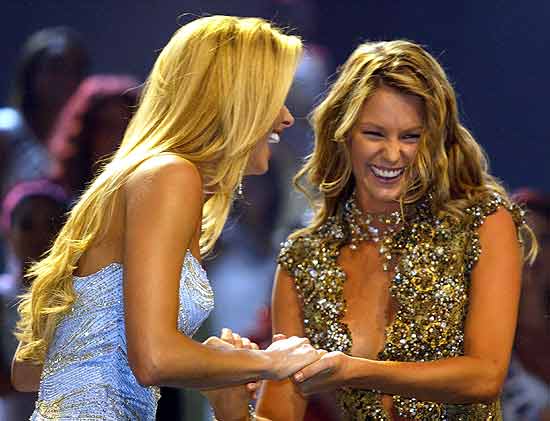
Some interesting factoids about Jennifer Hawkins, the newly-crowned Miss Universe 2004:
1. Last year, she finished third in the prestigious Bartercard Miss Indy 2003 pageant. If, for whatever reason, Bartercard Miss Indy 2003 and the first runner-up are unable to fulfill their obligations, Miss Hawkins would become the first woman in history to hold both titles simultaneously;
2. She was only selected to be "Miss Australia" last month by a Sydney modeling agency, thereby beating out last night, among others, Miss U.S.A., who was forced to compete in various pageants since last summer to earn her trip to Quito, Ecuador;
3. Her "original costume" was denounced by her hometown media as "unpatriotic", "boring", panicky and "universally, a disaster". Despite those props from her homies, she finished third in that segment, propelling her to the upset win;
4. By winning the crown, she became the first contestant outside of Latin America to win since 2000, and the first Miss Universe since 2002 to prevail without telling Miss Spain that she looked fat in her swimsuit just before she went on camera;
5. The new Miss Universe (on the right) has been quoted as saying that her ideal man is a bald, shlubby, 40-something left-of-center attorney who likes to down "a pint or two".

May 17, 2004

From today's Kausfiles: "I guess Kerry really is writing off the South!... Hello? Do Americans want a first daughter who parades around in a dress Paris Hilton would be embarrassed to wear ? And shouldn't she have, you know, thought of that? Even if she looks good in it."

Short answer: Yes !!!!! Has Kaus completely lost his mind? Why do I have the impression that his screensaver is a fish tank or a da Vinci drawing? If seeing Alexandra Kerry for the next four years is the price we have to pay, then screw the crackers. As well as any other NASCAR-loving, Iraqi-torturing, "Left Behind"-reading, sponging-off-the-Blue-State-taxpayer-while-whining-about-federal-government-spending, Toby Keith-and-The Judds-listening redneck. If we allow some special interest or regional bloc to determine whether a Presidential candidate is allowed to have an attractive daughter, then the terrorists will have won.