 Més que -- un blog
Detroit 88, Lakers 68: If the Lakers were a stock, this would be the perfect time to buy. In one week, they have gone from being prohibitive favorites to washed-up prima donnas, and they are still one game away from snatching back the home court advantage. Two one-sided losses, including the debacle on Thursday, will do much to diminish one's standing with the public. Yet this has been a fairly routine part of their season. It's hard to believe now, but the Lakers looked even worse in their two losses to San Antonio, and their collective effort in the two defeats in Minnesota was equally atrocious. Each time, they came back inspired, just as they did in Game 2 of this series.
If the series somehow does head back to L.A., fans might harken back to one of the bleaker moments in Laker history, when the team lost in seven to Boston in 1984. In that series, the Lakers went in as the underdog, then pulled away late to win Game 1 in Boston. After being outplayed for most of Game 2, they made a late run to take a lead, and seemingly had the series in the bag, especially after 85% free throw shooter Kevin McHale missed a pair with less than twenty seconds left and the Celtics down by two. But after a timeout, James Worthy threw a dreadful pass that was picked off by Gerald Henderson, who hit a lay-up to tie. The Lakers had the ball for the final shot, but their star, Magic Johnson, inexplicably dribbled out the clock, and they went on to lose in overtime.
And of course, in Game 3, the Lakers blew out the Celtics, and had seemingly regained control of the series, only to have McHale cheapshot Kurt Rambis in Game 4, and change the entire tone of the rivalry. In any event, the Pistons should win this series, especially with the Mailman and the Fisher King hurt, but the Lakers have already overcome enough self-inflicted adversity to get to the Finals. Anything less than two more complete defensive efforts by Detroit, and the Lakers will give Jackson his ninth title.
June 11, 2004
After a week of relentless hagiography, and genuinely classless and buffoonish antics by the media and my fellow citizens, I would be remiss if I didn't point out how genuinely moving the private ceremony at the Reagan Library was this evening. I had managed to avoid most of the remembrances the past week, busy as I was with work and Finals, but I did catch the sunset memorial. Anyone who has ever lost a family member or friend (and I would assume that would encompass almost everyone reading this post) can appreciate the dignity and charm the Reagan children revealed in their eulogies for their father. I delivered the eulogy for my late father, and it was one of the most difficult "performances" of my life; drafting and rehearsing the speech took a lot out of me, and knowing that I helped other people get a sense of who my dad really was still fills me with a sense of accomplishment. Hearing the recollections, and sharing the grief, of those who actually knew the man as a father and family member, rather than some stock political character, enables those of us who didn't share his views an opportunity to pay our respects as well.
June 09, 2004
Lakers 99, Detriot 91 [O.T.]: In defending Tom Lasorda from second-guessing following his decision to pitch to Jack Clark rather than Andy Van Slyke in Game 6 of the 1985 NLCS, Bill James once wrote that it is always easier to take the test after you know the answers. This morning, Larry Brown's decision to not foul any of the Lakers in the final fifteen seconds has raised hackles in every newspaper, radio show and barstool in the country, and the criticism is equally unfair.
The reasoning of Brown's attackers goes something like this: fouling a player immediately sends him to the line to shoot two, and the Pistons maintain the lead for at least two possessions. Much has been said about the supposed "unwritten rule" that teams never intentionally foul a player when that team is ahead by more than two points at the end of the game. What that obscures is the context of that decision. Even for a great player like Kobe Bryant, the likelihood of hitting a trey is ordinarily close to 33%; during the playoffs, when the opposing defense is, almost by definition, tougher, that percentage dips into the mid-to-high twenties.
On the other hand, Bryant is an 85% free throw shooter, so sending him to the line is a likely two-point gift. In order to have fouled Bryant before he was in the act of shooting would have required Rip Hamilton to have been almost on top of him by the time he got the ball, so the probable result in that situation would have been to stop the clock with about nine seconds to play (any hesitation on Hamilton's part in getting over to Bryant would have resulted in a shot attempt, sending Kobe to the line for three frees and a chance to tie, or even a chance for a four-point play). If he makes both free throws, the lead is one, Pistons' ball, but plenty of time to foul or cause a turnover. The Lakers still get another chance to tie or win the game. And that assumes Kobe makes both shots; if he misses the second, the Lakers happen to have the most dominant inside player in the game poised to get an offensive board and put-back, and you're looking at the same situation all over again.
And that, of course, assumes that Bryant gets fouled before he can get off a shot. But what if the Pistons had fouled O'Neal when he caught the in-bounds pass, twenty feet from the basket. Shaq gave up the ball almost immediately, so any attempt at playing Hack-a-Shaq would have been risky; if he had been fouled a millisecond after passing the ball to Walton, the Pistons would have been called for an intentional foul, sending Shaq to the line and giving the Lakers the ball out of bounds. Even with the Lakers' star's proclivity for inept free throw shooting, that would not have been a worthwhile risk for the Pistons.
So under the circumstances, Brown made the right call. The clock is the greatest ally for the team that's ahead in that situation. Each additional possession increases the chances for disaster, so the last thing a coach wants to do is stop the clock. Ten days ago, the Lakers had turned a nine-point deficit in Minnesota into a two-point deficit in the final ten seconds, using a maddening diet of threes and time outs. Playing for their lives, it is safe to say that the Lakers would have pulled out all the stops again in the final seconds, even with no timeouts remaining, had Detroit chosen to foul early. Only seconds earlier, when the Lakers were down by six, Bryant had bricked a wide-open three, and his fourth quarter shooting percentage from outside during the playoffs was mediocre, to say the least. By contesting Bryant but not fouling him, the odds were heavily in the Pistons' favor that he would miss, and the game (and series) would be over. It just didn't work out that way.
The reasoning of Brown's attackers goes something like this: fouling a player immediately sends him to the line to shoot two, and the Pistons maintain the lead for at least two possessions. Much has been said about the supposed "unwritten rule" that teams never intentionally foul a player when that team is ahead by more than two points at the end of the game. What that obscures is the context of that decision. Even for a great player like Kobe Bryant, the likelihood of hitting a trey is ordinarily close to 33%; during the playoffs, when the opposing defense is, almost by definition, tougher, that percentage dips into the mid-to-high twenties.
On the other hand, Bryant is an 85% free throw shooter, so sending him to the line is a likely two-point gift. In order to have fouled Bryant before he was in the act of shooting would have required Rip Hamilton to have been almost on top of him by the time he got the ball, so the probable result in that situation would have been to stop the clock with about nine seconds to play (any hesitation on Hamilton's part in getting over to Bryant would have resulted in a shot attempt, sending Kobe to the line for three frees and a chance to tie, or even a chance for a four-point play). If he makes both free throws, the lead is one, Pistons' ball, but plenty of time to foul or cause a turnover. The Lakers still get another chance to tie or win the game. And that assumes Kobe makes both shots; if he misses the second, the Lakers happen to have the most dominant inside player in the game poised to get an offensive board and put-back, and you're looking at the same situation all over again.
And that, of course, assumes that Bryant gets fouled before he can get off a shot. But what if the Pistons had fouled O'Neal when he caught the in-bounds pass, twenty feet from the basket. Shaq gave up the ball almost immediately, so any attempt at playing Hack-a-Shaq would have been risky; if he had been fouled a millisecond after passing the ball to Walton, the Pistons would have been called for an intentional foul, sending Shaq to the line and giving the Lakers the ball out of bounds. Even with the Lakers' star's proclivity for inept free throw shooting, that would not have been a worthwhile risk for the Pistons.
So under the circumstances, Brown made the right call. The clock is the greatest ally for the team that's ahead in that situation. Each additional possession increases the chances for disaster, so the last thing a coach wants to do is stop the clock. Ten days ago, the Lakers had turned a nine-point deficit in Minnesota into a two-point deficit in the final ten seconds, using a maddening diet of threes and time outs. Playing for their lives, it is safe to say that the Lakers would have pulled out all the stops again in the final seconds, even with no timeouts remaining, had Detroit chosen to foul early. Only seconds earlier, when the Lakers were down by six, Bryant had bricked a wide-open three, and his fourth quarter shooting percentage from outside during the playoffs was mediocre, to say the least. By contesting Bryant but not fouling him, the odds were heavily in the Pistons' favor that he would miss, and the game (and series) would be over. It just didn't work out that way.
June 08, 2004
The first poll to be released since the death of former President Reagan shows John Kerry moving out to a six-point lead over George Bush. According to Gallup, perhaps the most surprising aspect is that Kerry is within four points of Bush in the so-called "Red States", ie., states that the President won last time by more than five points. [link via Atrios]
June 06, 2004
The first draft of history: Juan Cole has an excellent recounting of Ronald Reagan's legacy, here. For all the talk of how Reagan, unlike the current occupant of the White House, was an optimist who could unite the public, not enough has been said this weekend about what a small, narrowminded hack he could be at times. His civil rights record, in particular, was dreadful; not only did he oppose the major legislation Congress passed during the 1960's, he infamously fought the extension of the Voting Rights Act during his Presidency, and attempted to extend tax breaks to segregated colleges such as Bob Jones U. His campaign for the Presidency in 1976 was based largely on attacking a fictitious "welfare queen" (wink, wink), an issue which encapsulated wedge politics during that era. The riots that ensued from the Rodney King trial in 1992 were an indirect result of Reagan's policies.
Perhaps his most significant political legacy was that the Republican Party became an unapologetically white movement during his administration, a triumph of Kevin Phillips' "Southern Strategy". When asked about the perception among many African-Americans that he was a bigot, he would defensively reply that, far from being a racist, he had always been a supporter of civil rights: in fact, back in the day when he recreated baseball games in Iowa, he claimed that he frequently pontificated against the color line from the broadcasting booth. It was perhaps a symptom of how obsequious the media was during that period that no one believed him, yet no one called him on that laughable assertion. He deserves enormous credit for joining with Gorbachev to end the Cold War; by treating the Soviet leader as a man that the West could do business with, he went against his own party, as well as many of the neo-conservatives that now dominate the current regime. But his domestic policies damaged the country irreparably, leading to the divisions that afflict us today.
Perhaps his most significant political legacy was that the Republican Party became an unapologetically white movement during his administration, a triumph of Kevin Phillips' "Southern Strategy". When asked about the perception among many African-Americans that he was a bigot, he would defensively reply that, far from being a racist, he had always been a supporter of civil rights: in fact, back in the day when he recreated baseball games in Iowa, he claimed that he frequently pontificated against the color line from the broadcasting booth. It was perhaps a symptom of how obsequious the media was during that period that no one believed him, yet no one called him on that laughable assertion. He deserves enormous credit for joining with Gorbachev to end the Cold War; by treating the Soviet leader as a man that the West could do business with, he went against his own party, as well as many of the neo-conservatives that now dominate the current regime. But his domestic policies damaged the country irreparably, leading to the divisions that afflict us today.
Detroit 87, Lakers 75: I have a feeling that the Lakers might need a couple of games to wake up in this series. Maybe Kobe needs to be falsely accused of murder....
June 05, 2004
CNN is reporting that Ronald Reagan passed away this morning. Having lost a grandfather to Alzheimer's, I can only express my sympathy to his family and loved ones at the travail they have gone through, and hope that his end came peacefully. There will be plenty of time later to discuss his legacy.
June 02, 2004
Remember when a number of pundits predicted that l'affaire Plame was so "over" after her photograph was published in Vanity Fair? If the President has to hire an outside counsel, it's gotten serious.
Some interesting factoids about Jennifer Hawkins, the newly-crowned Miss Universe 2004: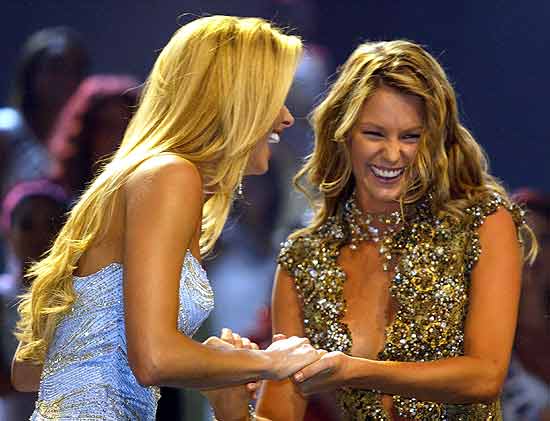
1. Last year, she finished third in the prestigious Bartercard Miss Indy 2003 pageant. If, for whatever reason, Bartercard Miss Indy 2003 and the first runner-up are unable to fulfill their obligations, Miss Hawkins would become the first woman in history to hold both titles simultaneously;
2. She was only selected to be "Miss Australia" last month by a Sydney modeling agency, thereby beating out last night, among others, Miss U.S.A., who was forced to compete in various pageants since last summer to earn her trip to Quito, Ecuador;
3. Her "original costume" was denounced by her hometown media as "unpatriotic", "boring", panicky and "universally, a disaster". Despite those props from her homies, she finished third in that segment, propelling her to the upset win;
4. By winning the crown, she became the first contestant outside of Latin America to win since 2000, and the first Miss Universe since 2002 to prevail without telling Miss Spain that she looked fat in her swimsuit just before she went on camera;
5. The new Miss Universe (on the right) has been quoted as saying that her ideal man is a bald, shlubby, 40-something left-of-center attorney who likes to down "a pint or two".
Accountability, then and now: GA Cerny has an apt post about how a different Republican leader acted sixty years ago.
A post about nothing: You ever had one of those days, when you set your mind to work on some big project, only to have your efforts come up completely empty. I spent yesterday chasing down a story that turned out to built on gossamer and string, concerning a throwaway remark made during the early panel at the AFI Saturday night, the one that involved the "Industry".
Allegedly, according to the panelists, a favorite film director of mine had worked "non-union" on one of his films, which, ironically, was a film about union organizing. I didn't get there until afterwards, so I had no way of knowing the context of what was said, and since the only person blogging that panel to have quoted that remark was either unable or unwilling to assist me when questioned, I decided to do my own factchecking. I had some free post-holiday time, and a jones to do some real, honest-to-goodness "journalism", like my hero, Matt Welch, so I dug into the story.
As the various journalism scandals of the past decade have taught us, from Judith Miller and Jeffrey Gerth to Jack Kelley and Jayson Blair, from the NY Times of coverage of Whitewater and Wen Ho Lee to the fictional stories about Al Gore claiming to have invented the Internet, people make s*** up all the time, and if you get suckered into believing something because someone in a position of authority says its true, you deserve everything else that happens. Gossip is fun to read, but it is often enough untrue (as this scathing piece, written by the "John Kerry Intern", attests), so it's always good to have a circumstantial basis for your story, as well as an eyewitness or three.
Since the person involved was, as I mentioned earlier, a film director, there would be one easy way to determine whether he was using non-union personnel on the shoot in question. I checked IMDB.com, and examined the various credits to find someone whose lack of experience prior to the movie would indicate that the crew member did not have a union card. No luck: each of the people I checked had extensive backgrounds at their positions. A newspaper column made mention of the same director's use of non-union personnel on a later film, but the context was different, it alluded to an interview over fifteen years old (which the article paraphrased from), and there was no explanation as to what his transgression was. I found no other websites that had even a tangential reference to the allegation, nor did I uncover any usenet groups that had bandied about the subject. If this was a Hollywood scandal, it doesn't appear to have generated much heat.
Finally, I asked my brother, who when he isn't running the hippest music club in town, is a Teamster organizer, whether the director in question had a bad rep when it came to such things. He pointed out that while it wouldn't surprise him to learn that an independent filmmaker, working on a tight budget, had been allowed to skirt union requirements, sometimes even with the tacit consent of the union, he really didn't know the answer (he wasn't involved with craft unions), but that if I really wanted to know, all I had to do was check for any grievances the affected unions would have filed back then. QED, if there were no grievances filed, then the parties probably had a pre-existing arrangement that allowed the director in question to skirt the rules.
That sounds like it might be hard work and heavy research, SO SCREW THAT. I'm not a journalist; I don't even have a library card, much less a subscription to NEXIS, so others will have to do the heavy lifting if they want the truth. Since I couldn't discredit the story after a thorough review of Google, and a ten-minute chat with my brother, each of the above subjects, from the director involved to the gossips who spread the story, shall remain nameless, but anyone who wants to uncover the details can easily do so. I'm a blogger, and not really a very good one at that, but at least I have enough self-respect not to gossip, nor to blindly post something based solely on how well I know my source. But if you ever want to know what I write about when I have absolutely nothing to write about, feel free to permalink this story.
Allegedly, according to the panelists, a favorite film director of mine had worked "non-union" on one of his films, which, ironically, was a film about union organizing. I didn't get there until afterwards, so I had no way of knowing the context of what was said, and since the only person blogging that panel to have quoted that remark was either unable or unwilling to assist me when questioned, I decided to do my own factchecking. I had some free post-holiday time, and a jones to do some real, honest-to-goodness "journalism", like my hero, Matt Welch, so I dug into the story.
As the various journalism scandals of the past decade have taught us, from Judith Miller and Jeffrey Gerth to Jack Kelley and Jayson Blair, from the NY Times of coverage of Whitewater and Wen Ho Lee to the fictional stories about Al Gore claiming to have invented the Internet, people make s*** up all the time, and if you get suckered into believing something because someone in a position of authority says its true, you deserve everything else that happens. Gossip is fun to read, but it is often enough untrue (as this scathing piece, written by the "John Kerry Intern", attests), so it's always good to have a circumstantial basis for your story, as well as an eyewitness or three.
Since the person involved was, as I mentioned earlier, a film director, there would be one easy way to determine whether he was using non-union personnel on the shoot in question. I checked IMDB.com, and examined the various credits to find someone whose lack of experience prior to the movie would indicate that the crew member did not have a union card. No luck: each of the people I checked had extensive backgrounds at their positions. A newspaper column made mention of the same director's use of non-union personnel on a later film, but the context was different, it alluded to an interview over fifteen years old (which the article paraphrased from), and there was no explanation as to what his transgression was. I found no other websites that had even a tangential reference to the allegation, nor did I uncover any usenet groups that had bandied about the subject. If this was a Hollywood scandal, it doesn't appear to have generated much heat.
Finally, I asked my brother, who when he isn't running the hippest music club in town, is a Teamster organizer, whether the director in question had a bad rep when it came to such things. He pointed out that while it wouldn't surprise him to learn that an independent filmmaker, working on a tight budget, had been allowed to skirt union requirements, sometimes even with the tacit consent of the union, he really didn't know the answer (he wasn't involved with craft unions), but that if I really wanted to know, all I had to do was check for any grievances the affected unions would have filed back then. QED, if there were no grievances filed, then the parties probably had a pre-existing arrangement that allowed the director in question to skirt the rules.
That sounds like it might be hard work and heavy research, SO SCREW THAT. I'm not a journalist; I don't even have a library card, much less a subscription to NEXIS, so others will have to do the heavy lifting if they want the truth. Since I couldn't discredit the story after a thorough review of Google, and a ten-minute chat with my brother, each of the above subjects, from the director involved to the gossips who spread the story, shall remain nameless, but anyone who wants to uncover the details can easily do so. I'm a blogger, and not really a very good one at that, but at least I have enough self-respect not to gossip, nor to blindly post something based solely on how well I know my source. But if you ever want to know what I write about when I have absolutely nothing to write about, feel free to permalink this story.
May 31, 2004
May 30, 2004
The American Cinema Foundation hosted its annual blogger panel at the AFI last night, affirming the notion that Los Angeles is to the blogosphere what Tobacco Road is to college basketball. Ninety minutes spent listening to the views and brainfarts of Matt Welch, Mickey Kaus, Charles Johnson, Roger Simon, "Moxie", and Kevin Drum, before a packed but non-violent crowd of my fellow pundit wannabees, trolls and derelicts, is always a great way to spend a Saturday night, especially with the Lakers tanking the way they did. More politically diverse than last year's panel, ranging from center-left to "little green-eyed monsters", but (sadly) with less input from those non-political sites that I feel represent the future of this medium, the focus was on the motivation of the panelists in using the blogging format to get out their message. Since each of the bloggers used a different path to get where they are, it served only to reinforce the point that if you want a lot of hits, you need to spend a lot of free time before a computer terminal. Local Mean Girl "Cecile" blogged the festivities in real time with exceeding precocity. Others attending included Cathy Seipp, Luke Ford, Emmanuelle Richard, Martin Devon, "Boi from Troy" and Amy Alkon.
Then afterwards, no blogapalooza could be complete without the after-party salon at the home of the eminent voice of Reason, Mr. Welch, and his lovely wife. The gorgeous "Moxie" enthralled the guests well into the wee hours with her wit and beauty, although she seemed to go out of her way to skewer a hypothetical loser as being the "bald, fat guy from high school". I guess I'm not her type; it's amazing how a woman can intuit that without ever visiting this site.
Then afterwards, no blogapalooza could be complete without the after-party salon at the home of the eminent voice of Reason, Mr. Welch, and his lovely wife. The gorgeous "Moxie" enthralled the guests well into the wee hours with her wit and beauty, although she seemed to go out of her way to skewer a hypothetical loser as being the "bald, fat guy from high school". I guess I'm not her type; it's amazing how a woman can intuit that without ever visiting this site.
May 28, 2004
Mr. Samgrass to the defense: Christopher Hitchens continues the saddest descent into irrelevance since Ramsey Clark by defending Ahmad Chalabi. None of this would be happening if Rickey Ray Rector was still alive !! [link via GA Cerny]
May 27, 2004
French actress Julie Delpy is profiled in this week's LA City Beat. She is a gorgeous woman who can't act worth crap, sort of like a Gallic version of Kate Beckinsale, but she did star in two of the most unintentionally hilarious movies of the late 20th Century, "Beatrice" and "Killing Zoe". She's also identified as a "writer-director" in the article, no doubt covering herself for that time five years from now when the date on her birth certificate unofficially ends her acting career.
UPDATE: As it turns out, Mlle. Delpy may have a very interesting career ahead of her, if this script is any indication. Following in the footsteps of Orson Welles, Woody Allen, Clint Eastwood, and Jon Favreau, she is slated to write, direct and star in this film, based on the life of Countess Erzebet Bathory, a beautiful sixteenth century Hungarian noblewoman whose hobby was torturing and eviscerating the bodies of young virgins, supposedly in a desperate attempt to remain eternally beautiful (it's a true story, and I'm already kicking myself for not including her in this article).
The film's producer insists that this won't just be another horror film out of the Hammer Film genre: "Usually they've linked (Bathory) to vampirism and all sorts of nonsense. Julie has written a serious movie that tells this in both historical and political terms." One way in which the blonde auteur addresses the "historical and political" significance of the infamous Countess, who is thought to have murdered over 600 young women, is through exploring the deeply spiritual ends she was pursuing, such as the ambivalence she feels as she prays to the Virgin Mary:
UPDATE: As it turns out, Mlle. Delpy may have a very interesting career ahead of her, if this script is any indication. Following in the footsteps of Orson Welles, Woody Allen, Clint Eastwood, and Jon Favreau, she is slated to write, direct and star in this film, based on the life of Countess Erzebet Bathory, a beautiful sixteenth century Hungarian noblewoman whose hobby was torturing and eviscerating the bodies of young virgins, supposedly in a desperate attempt to remain eternally beautiful (it's a true story, and I'm already kicking myself for not including her in this article).
The film's producer insists that this won't just be another horror film out of the Hammer Film genre: "Usually they've linked (Bathory) to vampirism and all sorts of nonsense. Julie has written a serious movie that tells this in both historical and political terms." One way in which the blonde auteur addresses the "historical and political" significance of the infamous Countess, who is thought to have murdered over 600 young women, is through exploring the deeply spiritual ends she was pursuing, such as the ambivalence she feels as she prays to the Virgin Mary:
"Am I doing the right thing? Perhaps the blood is not helping my skin so much. I have been having rashes of late. Probably some unclean blood. But still I feel something is missing in my life."What woman couldn't relate? I am so there on opening night !!
May 26, 2004
If there's any validity to this story, the only question left to decide in Eagle, Colorado will be how much money the taxpayers have to fork over to Kobe Bean Bryant for his pain and suffering. Prosecutors should not be in the business of bringing criminal charges to prove a point, or to show they can.
It shouldn't surprise anyone, but the latest Field Poll has Kerry beating Bush in California by 15 points. The poll also finds that Kerry has built a 40-point lead among Latinos, while the candidates are essentially even amongst everyone else (see this post for the paramount significance of the Latino vote for Democratic candidates). Kerry not only is blowing out the President in liberal strongholds like San Francisco and LA Counties, he also a significant lead in the Republican-leaning Central Valley, and a tiny lead in Orange and San Diego Counties(!)
The person elected President by the American people speaks:
George W. Bush promised us a foreign policy with humility. Instead, he has brought us humiliation in the eyes of the world.--Al Gore, 5-26-2004
He promised to "restore honor and integrity to the White House." Instead, he has brought deep dishonor to our country and built a durable reputation as the most dishonest President since Richard Nixon.
Honor? He decided not to honor the Geneva Convention. Just as he would not honor the United Nations, international treaties, the opinions of our allies, the role of Congress and the courts, or what Jefferson described as "a decent respect for the opinion of mankind." He did not honor the advice, experience and judgment of our military leaders in designing his invasion of Iraq. And now he will not honor our fallen dead by attending any funerals or even by permitting photos of their flag-draped coffins.
(snip)
There was then, there is now and there would have been regardless of what Bush did, a threat of terrorism that we would have to deal with. But instead of making it better, he has made it infinitely worse. We are less safe because of his policies. He has created more anger and righteous indignation against us as Americans than any leader of our country in the 228 years of our existence as a nation -- because of his attitude of contempt for any person, institution or nation who disagrees with him.
He has exposed Americans abroad and Americans in every U.S. town and city to a greater danger of attack by terrorists because of his arrogance, willfulness, and bungling at stirring up hornet's nests that pose no threat whatsoever to us. And by then insulting the religion and culture and tradition of people in other countries. And by pursuing policies that have resulted in the deaths of thousands of innocent men, women and children, all of it done in our name.
President Bush said in his speech Monday night that the war in Iraq is "the central front in the war on terror." It's not the central front in the war on terror, but it has unfortunately become the central recruiting office for terrorists. [Dick Cheney said, "This war may last the rest of our lives.] The unpleasant truth is that President Bush's utter incompetence has made the world a far more dangerous place and dramatically increased the threat of terrorism against the United States.
May 23, 2004
Solitudinem faciunt, pacem appellant: Morgue records from Baghdad and three outlying provinces indicate that over 5,500 Iraqi civilians have been killed since President Bush declared major hostilities at an end last May. That figure does not include deaths from areas such as Fallujah and Najaf, nor does it encompass the vast majority of insurgent deaths, which typically do not get handled by the morgue, and it constitutes a dramatic increase from the pre-war statistics.
It is becoming quite evident that the electorate needs to send a loud and conclusive message to the people who have gotten us into this mess. Ultimately, responsibility must rest with the moron who was entrusted with supreme power in this country, but failed to exercise it with any sense of discretion or accountability. The news this week that Ahmad Chalabi, the man who was the focus of our post-war Iraqi policy, was in fact little more than a grifter in bed with the Iranian mullahcracy, is even more depressing when one realizes that the President will hold no one accountable for that fiasco, just as he has held no one accountable for Abu Ghraib, for the non-existence of WMD's, and for the inattention to planning for the post-Saddam era in Iraq.
These people must not simply be defeated in the polling booth this November; they must be thoroughly and eternally discredited. As Rome did to Carthage twenty-two centuries ago, salt must sown into the decrepit remains of neo-conservatism, so that no one from this Administration can ever obtain gainful employment in the corridors of power again. The Republican Party must be forced to purge this ideology forthwith, or face the consequences of being in the political wilderness for the next three decades.
It is becoming quite evident that the electorate needs to send a loud and conclusive message to the people who have gotten us into this mess. Ultimately, responsibility must rest with the moron who was entrusted with supreme power in this country, but failed to exercise it with any sense of discretion or accountability. The news this week that Ahmad Chalabi, the man who was the focus of our post-war Iraqi policy, was in fact little more than a grifter in bed with the Iranian mullahcracy, is even more depressing when one realizes that the President will hold no one accountable for that fiasco, just as he has held no one accountable for Abu Ghraib, for the non-existence of WMD's, and for the inattention to planning for the post-Saddam era in Iraq.
These people must not simply be defeated in the polling booth this November; they must be thoroughly and eternally discredited. As Rome did to Carthage twenty-two centuries ago, salt must sown into the decrepit remains of neo-conservatism, so that no one from this Administration can ever obtain gainful employment in the corridors of power again. The Republican Party must be forced to purge this ideology forthwith, or face the consequences of being in the political wilderness for the next three decades.
Subscribe to:
Posts (Atom)